Memaparkan catatan dengan label Paddle Design. Papar semua catatan
Memaparkan catatan dengan label Paddle Design. Papar semua catatan
Selasa, 9 Disember 2014
Paddle from Jonas - Sweden
Many of you might know I routinely feature creations from other paddlemakers. Blog reader Jonas from Sweden has recently discovered the joy of carving custom paddles and sent in some photos of an experimental design.
This one features a pointed, spear like blade. The inspiration for his custom carved grip came from the Etched Coast Salish Paddle posted back in January of 2013. The 64cm shaft is a transitional shape, going from round at the base of the grip to oval at the blade neck.

The grain pattern on Jonas' blade is incredibly straight - a great indicator of excellent wood selection. Also impressive is that this paddle was not sanded but carefully scraped smooth which adds a lot more work to the project.

The paddle is finish in an experiment mixture of raw oxidated linseed oil, pitch oil and tar on the blade and shaft with just oil for the grip. You can just make out the subtle colour difference between these sections

Finally, Jonas has decided to start his own paddle making blog to document his journey in this fun hobby. Right now it is brand new with a short series of informative posts on paddle design and a fascinating post about the use of tar and shellac in Sweden as a finish for canvas canoes. Check it out at PaddleReflections.blogspot.com
Read More..
This one features a pointed, spear like blade. The inspiration for his custom carved grip came from the Etched Coast Salish Paddle posted back in January of 2013. The 64cm shaft is a transitional shape, going from round at the base of the grip to oval at the blade neck.
Jonas' Experimental Design
130 cm Spear Blade
The grain pattern on Jonas' blade is incredibly straight - a great indicator of excellent wood selection. Also impressive is that this paddle was not sanded but carefully scraped smooth which adds a lot more work to the project.
Straight grain pattern on blade
Custom carved grip
Finally, Jonas has decided to start his own paddle making blog to document his journey in this fun hobby. Right now it is brand new with a short series of informative posts on paddle design and a fascinating post about the use of tar and shellac in Sweden as a finish for canvas canoes. Check it out at PaddleReflections.blogspot.com

Selasa, 21 Oktober 2014
Rice Lake Canoe Catalog Paddles
Archive.org has a copy of the Rice Lake Canoe Co. Catalogue dated to 1900. The company was one of the many builders in southeastern Ontario at the turn of the 20th century and it's well illustrated catalogue showcases many style of canoes being built at the time. A short history of the company can be read here for anyone interested.
Page 14 of the document a full page ad with a series of paddles. They're all long deep-water paddles consistent with the deep lake water conditions of region. Check out those prices...$1.00 for an oiled Maple, Ash, or Spruce paddle!


Read More..
Page 14 of the document a full page ad with a series of paddles. They're all long deep-water paddles consistent with the deep lake water conditions of region. Check out those prices...$1.00 for an oiled Maple, Ash, or Spruce paddle!
Rice Lake Canoe Co. - Paddle Closeups
Selasa, 14 Januari 2014
Historic Paddle Illustration: D.C. Beard - BoatBuilding and boating (1911)
Archive.org has a free online edition of Boat-building and boating (1911) by Daniel Carter Beard. Chapter VI features bark canoe construction. The images look to be replicas of Adney's famous sketches and are quite detailed. On page 60 is a crude sketch of some paddles with rough dimensions. The only detailed provided is a brief caption posted below:

Read More..
Paddles are made of rock maple, and sometimes of birch and even cedar. Bow paddles are usually longer and narrower in the blade than stern paddles (Fig. 101).

Isnin, 14 Januari 2013
Malecite St.John River Paddle
Another one of the paddles on my ever growing "to do list" is the 1896 Malecite St.John River Paddle documented in Adney's Bark Canoes and Skin Boats of North America. The blade looks to be standard beavertail with a distinct spine, but the grip has some rectangular features and a carved drip ring which suites the paddle nicely.

Adney's St. John Malecite Pattern
After casually examining some of my books the other day, I recognized this grip pattern on the cover of Graham Warren's must have paddle making book, Canoe Paddles: A Complete Guide to Making Your Own. The grip is featured near the bottom right of his book cover..

G Warren's book cover, St.John Malecite grip on lower right
Warren's first publication (which I blogged about here) has a complete illustration with a table of offsets for this pattern as well. Graham has also graciously re-published an article on his website entitled The Malecite St.John River Paddle (.pdf format) that appeared in Open Canoe in 1996 which features the detailed pattern for anyone interested in this design. The 2011 article entitled "Know Your Paddles" by Beth Stanley in Canadian Woodworking also has a closeup shot of this grip featured below.

St. John River Malecite Grip
At this stage though, it'll be while before I start this one. Still waiting to be completed is the decoration on the Yellow Birch York Sunbury replica. Plus I've been working on some more canoe related homemade camping gear that'll be posted on soon.
Read More..

Adney's St. John Malecite Pattern
After casually examining some of my books the other day, I recognized this grip pattern on the cover of Graham Warren's must have paddle making book, Canoe Paddles: A Complete Guide to Making Your Own. The grip is featured near the bottom right of his book cover..

G Warren's book cover, St.John Malecite grip on lower right
Warren's first publication (which I blogged about here) has a complete illustration with a table of offsets for this pattern as well. Graham has also graciously re-published an article on his website entitled The Malecite St.John River Paddle (.pdf format) that appeared in Open Canoe in 1996 which features the detailed pattern for anyone interested in this design. The 2011 article entitled "Know Your Paddles" by Beth Stanley in Canadian Woodworking also has a closeup shot of this grip featured below.

St. John River Malecite Grip
Jumaat, 21 Disember 2012
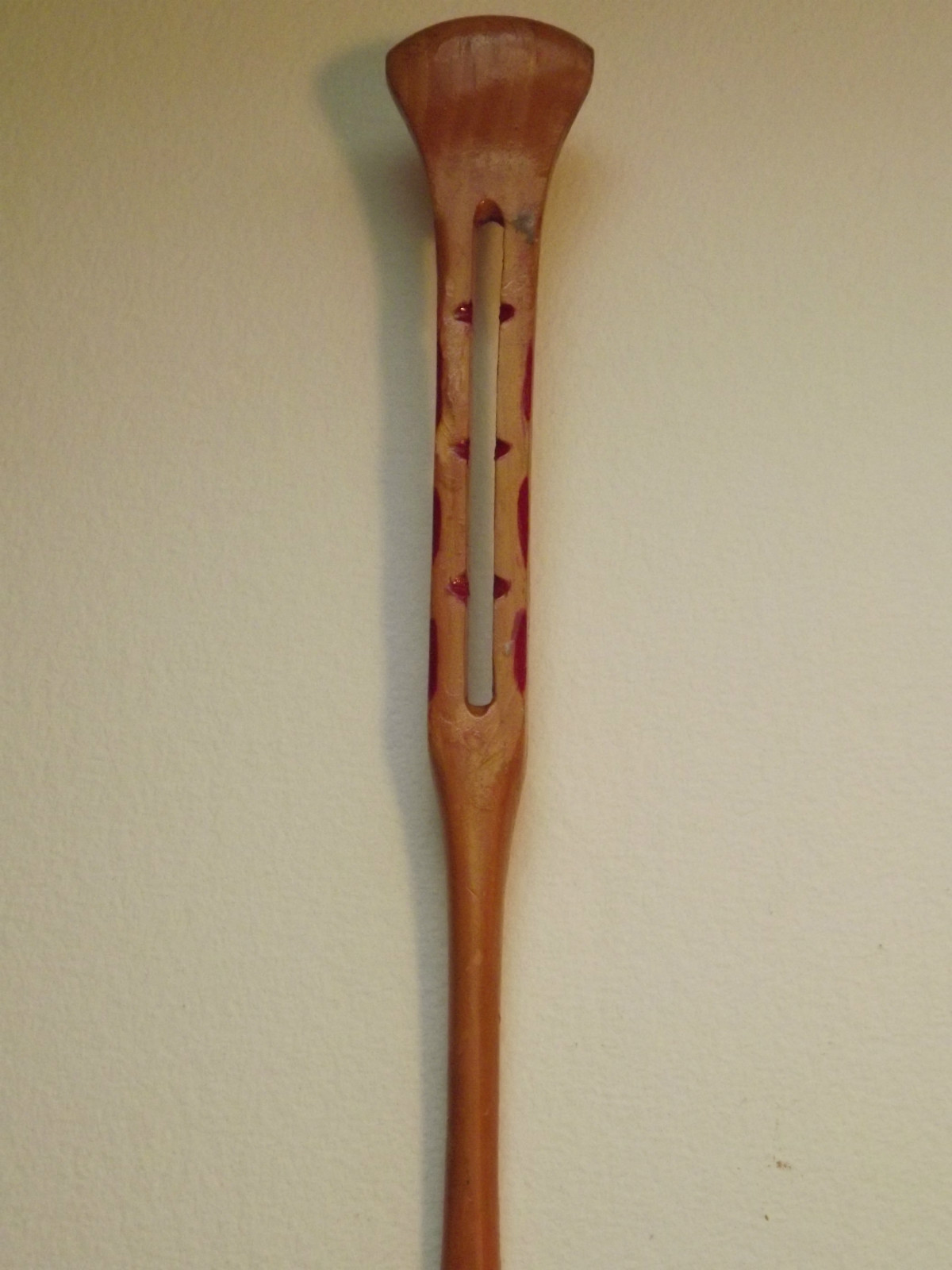
Miniature Slotted Grip Paddle
Another interesting Ebay Listing featuring a 16 1/2 inch model paddle. The grip area looks interesting with its slotted interior. Might be an interesting one to replicate at full scale...


Read More..

Khamis, 12 April 2012
New Biomimicry Paddle Design
Longtime blog reader Bryan (who recently started a paddling business - Cold Spring Paddling - sent me an email of a creative paddle project by Chad Townsend of Banff, Alberta. It's called the Shearwater webbed paddle which aims to combine mechanical engineering, evolutionary biology, and modern material capabilities.

Some details of their product from their website:
Read More..

Some details of their product from their website:
- a practical application of �biomimicry' (copying nature's engineering / efficiency);
- a uniquely compact paddle adaptable for a variety of water sports (webbed blade folds inward, and shaft breaks down for storage and transport);
- an educational tool for science centers, camps, and parks.
Jumaat, 30 Disember 2011
Peabody Passamquoddy Paddle Sketch
Came across a wonderful illustration of a paddle in an out of print children's book, Discovering Canada: The Fur Traders. It is another version of the c1849, green and white painted Passamaquoddy paddle at the Peabody Museum.
I've posted on this paddle many times before as it is the basis for the paddle in the header of the site and one of my favourite blade designs. Here is the version illustrated by Tappen Adney and the new one by illustrator A.G. Smith.

Adneys's Illustration

A.G. Smith's illustration
Read More..
I've posted on this paddle many times before as it is the basis for the paddle in the header of the site and one of my favourite blade designs. Here is the version illustrated by Tappen Adney and the new one by illustrator A.G. Smith.

Adneys's Illustration

A.G. Smith's illustration
Selasa, 13 Disember 2011
Historic Paddle Illustration - Canadian Field-Naturalist
An article entitled, "Canadian Aboriginal Canoes" originally published in Canadian Field-Naturalist Vol XXXIII(2), May 1919 appears on Archive.org. The well written article features some wonderful illustrations of various bark canoe designs as well as sketch of some different paddles shapes (mostly NorthWest coast designs)


Read More..


Jumaat, 28 Oktober 2011
Woodpecker Paddle Art
Check out this awesome Woodpecker paddle art piece made by Joanna Haslem at Owl's Pen.

Carved Woodpecker Paddle

Closeup

Closer Closeup
Read More..

Carved Woodpecker Paddle

Closeup

Closer Closeup
Ahad, 30 Mei 2010
Poplar Diamond Passamaquoddy - Part 3
While up north for the recent holiday weekend, I managed to get in some paddle carving time to finalize the nearly complete c. 1849 Passamaquoddy replica begun back in January. Here's a shot by the lakeside on a bright, brisk day using the picnic table "workbench". The communal beach all groomed and loungers all set for the upcoming tourist season.

Carving by the lake
After wetting the grain and sanding it down, I brought the paddle back home to the city. Yellow Poplar certainly makes for a lightweight paddle - my official quality control tester had a easy time lifting it with one hand and running around the place with it.


Rigorous Quality Testing
The major item I struggled with in this design was balancing the paddle...in the end it just ended up being too blade heavy. Kind of obvious I guess given the large shape and the relatively small handle. My feeling is that perhaps the original paddle documented by Adney would've been balanced, but only because the paddle was illustrated as being much longer than my replica (71.5" vs. my 58" version).

Adney's sketch - Diamond Bladed Passamaquoddy in middle
Had I digitally reduced the paddle to scale to fit my preferred paddle length, the blade size would've been unusually small. Still, in the future when replicating longer paddle designs to a my own functional paddle length, this will need to be considered if a throat-balanced paddle is the final goal.
In any event, it's ready for the decoration stage and I've decided to keep this one much more simple than the recent Northwoods paddle where I went overboard.
MAY 24, 2011 Update: Paddle finally completed...go to Part 4
Read More..

Carving by the lake
After wetting the grain and sanding it down, I brought the paddle back home to the city. Yellow Poplar certainly makes for a lightweight paddle - my official quality control tester had a easy time lifting it with one hand and running around the place with it.


Rigorous Quality Testing
The major item I struggled with in this design was balancing the paddle...in the end it just ended up being too blade heavy. Kind of obvious I guess given the large shape and the relatively small handle. My feeling is that perhaps the original paddle documented by Adney would've been balanced, but only because the paddle was illustrated as being much longer than my replica (71.5" vs. my 58" version).

Adney's sketch - Diamond Bladed Passamaquoddy in middle
Had I digitally reduced the paddle to scale to fit my preferred paddle length, the blade size would've been unusually small. Still, in the future when replicating longer paddle designs to a my own functional paddle length, this will need to be considered if a throat-balanced paddle is the final goal.
In any event, it's ready for the decoration stage and I've decided to keep this one much more simple than the recent Northwoods paddle where I went overboard.
MAY 24, 2011 Update: Paddle finally completed...go to Part 4
Khamis, 8 April 2010
Blog Inspired Paddles
Kent Lund sent me a kind email mentioning how a few of the various paddle types featured on the site got him inspired to get back into the paddle making hobby. Check out his fantastic growing collection below which features a nice mix of decorated blades and interesting grip designs:

Kent's growing paddle collection
Many readers of the blog might recognize the 2nd paddle from the right. Kent's version of the Snake Paddle featured back in December of '09. With some extra techniques on the paint job, Kent was able to give the paddle an antique look. Great stuff!
To further personalize some of the paddles, a striped banding around the shafts was added - a customized idea based on a pattern on his daughter's favorite jacket. A unique way to add even more meaning to a family paddle.
As an extra aside, Kent asked me about techniques for giving varnish an aged look. But I not really familiar with any methods that give an authentic, antique appearance. If anyone has suggestions, please comment so we can all learn more. Click the Leave a comment link below the post.
Read More..

Kent's growing paddle collection
Many readers of the blog might recognize the 2nd paddle from the right. Kent's version of the Snake Paddle featured back in December of '09. With some extra techniques on the paint job, Kent was able to give the paddle an antique look. Great stuff!
To further personalize some of the paddles, a striped banding around the shafts was added - a customized idea based on a pattern on his daughter's favorite jacket. A unique way to add even more meaning to a family paddle.
As an extra aside, Kent asked me about techniques for giving varnish an aged look. But I not really familiar with any methods that give an authentic, antique appearance. If anyone has suggestions, please comment so we can all learn more. Click the Leave a comment link below the post.
Jumaat, 2 April 2010
Paddle Blade Warping Problem
Michael Weiser, a reader of the blog, sent me some pics and details of a few paddles he has made. They include 2 laminated versions patterned after Adney's Attikamekw paddle plan and two Northwoods paddles (Stern and Bow). Great looking stuff.

Michael's paddle collection
A problem emerged with his Northwoods bow paddle however. Since these were carved from maple, they were significantly thinned to reduce weight. When dry, the paddle is a "picture of straightness" according to Michael, but upon contact with moisture, the blade severely warps. The paddle was made from flat sawn wood stock with a grain pattern that one would assume, would be pretty ideal for strength and flex. A closeup of the tip reveals the distinct growth rings curving upwards and contributing to the cupping at the tip however.

Grain Pattern on tip

The resultant warping when wet
In addition to discussing issues with low moisture content of the wood stock, Michael also had some other points which add to the mystery. Generally, a dense pattern of annual rings make a wood less prone to warping, but other paddles with even wider spaced annual rings don't warp as much as his paddle. In addition, the larger to radius of the growth rings (a function of the girth of the tree), the flatter the rings appear and the less warping. But Michael's impression is that others have made paddles from similar stock without warping problems.
We've been discussing the options to deal with the absorption through the end grain at the tip, including using varnish (the paddles were originally oiled), sealing with epoxy, etc. But if any other any readers have other suggestions or explanations to this mystery, please feel free to post a comment.
Michael also took the liberty of preparing some basic stats on paddle surface area to illustrate the huge size of the Stern Northwoods. See the info below:
Certainly not a paddle ideal for solo paddling, but advantageous for steering and controlling a heavily loaded tripping canoe down some deep moving water.
Read More..

Michael's paddle collection
A problem emerged with his Northwoods bow paddle however. Since these were carved from maple, they were significantly thinned to reduce weight. When dry, the paddle is a "picture of straightness" according to Michael, but upon contact with moisture, the blade severely warps. The paddle was made from flat sawn wood stock with a grain pattern that one would assume, would be pretty ideal for strength and flex. A closeup of the tip reveals the distinct growth rings curving upwards and contributing to the cupping at the tip however.

Grain Pattern on tip

The resultant warping when wet
In addition to discussing issues with low moisture content of the wood stock, Michael also had some other points which add to the mystery. Generally, a dense pattern of annual rings make a wood less prone to warping, but other paddles with even wider spaced annual rings don't warp as much as his paddle. In addition, the larger to radius of the growth rings (a function of the girth of the tree), the flatter the rings appear and the less warping. But Michael's impression is that others have made paddles from similar stock without warping problems.
We've been discussing the options to deal with the absorption through the end grain at the tip, including using varnish (the paddles were originally oiled), sealing with epoxy, etc. But if any other any readers have other suggestions or explanations to this mystery, please feel free to post a comment.
Michael also took the liberty of preparing some basic stats on paddle surface area to illustrate the huge size of the Stern Northwoods. See the info below:
| Attikamekw 11cm wide/64cm long Attikamekw 12cm wide/70cm long Northwoods Bow Grey Owl Chieftain Grey Owl Tripper Graham Warren's Ottertail Graham Warren's Voyageur Graham Warren's Traditional Beavertail Northwoods Stern | 569 cm / 88 sq in 683 cm2 / 105 sq in 798 cm2 / 123 sq in 800 cm2 / 124 sq in 820 cm2 / 127 sq in 829 cm2 / 128 sq in 895 cm2 / 138 sq in 938 cm2 / 145 sq in 966 cm2 / 149 sq in |
Certainly not a paddle ideal for solo paddling, but advantageous for steering and controlling a heavily loaded tripping canoe down some deep moving water.
Khamis, 17 Disember 2009
Snake Eyes Folk Art Paddle
Many thanks to Ferdy Goode for sending me a link to an interesting paddle posted at Gould Auctions. Might try making one of these (yet another project!) although with the Mrs. afraid of snakes, I'm not sure if she'd appreciate this one hanging on the wall.
.jpg)


Read More..
.jpg)


A STUNNING 19th century Folk Art carved and painted, full sized CANOE PADDLE in a SUPERIOR original surface. Its shaft is formed by a full relief carved red snake which has yellow glass eyes and a green belly! The paddle measures 67� in length. Found in a Greenville, Maine home. SUPERB original condition.
Jumaat, 11 Disember 2009
Graham Warren Paddlemaking DVD
 Just found out about a new Paddlemaking DVD (scroll down) from Graham Warren of Moosehead Canoes. I've already got both of Graham's paddlemaking books and this DVD looks like it would make a nice visual addition to the library.
His site has some beautiful looking screen shots as well as details of the content. The 90 minute DVD is currently only available in PAL region 2 (UK & Europe) format but a NTSC (North American) format is apparently coming soon. The disc also contains 10 full sized paddle plans in electronic PDF format to print out - very handy.
Khamis, 3 Disember 2009
Canoe Paddle Plans
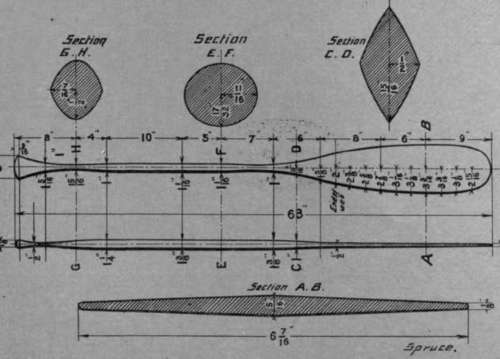
From the 1905 online book, Problems in Woodworking, is a chapter about canoe paddles. Included is a diagram of a standard beavertail paddle with pear grip showing all the relevant specs for width, length, and thickness. Interesting to note the thinning of the circular shaft (1-1/8th inch) down to 1 inch at the throat of the blade. I generally make the shafts on my paddles 1-1/8th inch thick as well but never really thinned the throat like this plan shows. Logically I wonder if it would weaken the paddle right at this location where the large blade area of this design would presumably concentrate the most force.

Paddle Plans
Read More..
Paddle Plans
Jumaat, 30 Oktober 2009
Exotic Paddle Series (4) - New Zealand Hoe
A beautifully carved Maori paddle (Hoe) from Steve Pyne. The blade is stunning of course, but check out the hollowed loop on the shaft. Never seen anything like it!

Details & Description from his site:
Read More..
Details & Description from his site:
Hoe is a canoe paddle. The highly decorated versions would normally be used for ceremonial purposes by the Chief's. Decorative work in which notched ridges run parallel to one, two or three plain ridges is termed Rauponga. Within the design the plain ridges are known as Patapata and the hollows between the ridges as Haehae, while the notched ridge itself is termed Pakati. Each individual notch is an Arapata and they form a diamond pattern called Tuara-kuri. The eyes are inlaid with paua amore colourful relative of the abalone. The spirals serve as points of movement or joint marks, for the jaw, shoulders, elbow & hips. The "three fingered hand" is found on many ancestral figures, some also show a back-bending thumb or spur. This shows an avian feature superimposed on the human image.Length: 1660mm
Width: 155mm
Sabtu, 10 Oktober 2009
NMAI Decorated Algonquin Paddle
A decorated Algonquin paddle from the National Museum of the American Indian. First time I've seen this decoration pattern and no idea about its significance but if the date of this paddle is correct (1780-1820) it shows that the flat extended grip has been in use for many centuries. This corroborates the circa 1770s Cree Paddle design I posted on before. Unfortunately there are no dimensions provided, but from the general shape of it, it would seem to make a beautiful solo paddle.

Date created: 1780-1820
Place: Eastern Canada
Collection history unknown; formerly in the collection of the Peabody Museum of Salem (now the Peabody Essex Museum); acquired by MAI via an exchange with the Peabody Museum in 1963.
Catalog number:23/2290
Read More..

Date created: 1780-1820
Place: Eastern Canada
Collection history unknown; formerly in the collection of the Peabody Museum of Salem (now the Peabody Essex Museum); acquired by MAI via an exchange with the Peabody Museum in 1963.
Catalog number:23/2290
Ahad, 20 September 2009
Walnut Laminated Voyageur
A common paddle design marketed today is the so called "Voyageur" blade, essentially a straight side paddle with a wide, squarish tip, and recurved shoulders at the throat. Despite the persistant occurance of this design in modern stores, there is little evidence that it resembles anything that the real voyageurs may have actually paddled. Certainly in the paintings of Frances Anne Hopkins, the paddles don't resemble this blade design. The only other time I've seen the recurved shoulder design is with an early Mi'kmaq design documented by Adney.
Graham Warren refers to this design more precisely as a "North West Voyageur" simply because it appears in the voyageur art of Howard Sivertson. For some examples, I checked out a book of his entitled, The Illustrated Voyageur: Paintings and Companion Stories which has some delightful anecdotes and illustrations, although probably not entirely accurate.

In any event, I had made this blank many months ago from scraps of black walnut and a 3/4" wide strip of yellow poplar. Given the small width of the poplar, the walnut was laminated from the grip all the way to the blade resulting in a neat contrasting look in the shaft area. Walnut and Yellow Poplar are both very easy to carve and the simple, straight edges meant that cutting out and shaving down the blade and grip was very quick. This was one of the fastest paddles I carved out from a blank. Here are some pics of the job.


Unfinished paddle; Blade Closeup
Since I was using left over cutoff scraps, the grain pattern isn't perfectly symmetrical on the blade. There's also point on the blade where the grain reverses suddenly giving the appearance of a horizontal "scratch".
I've read plenty of criticisms of this blade design on canoeing forums with many paddlers literally calling this blade shape a piece of junk. Personally I found it an acceptable design although the larger squarish tip certainly made for a noisy entry and the recurved shoulders tended to cause some cavitation and loss of power when paddling with a quick pace. But I found that if I slowed down and relaxed the pace it handled well with underwater recoveries. The walnut-poplar lamination also resulted in a super-light paddle and there's no denying the rich-chocolatey appeal of the wood. Instead of adding any additional pyrography to this one, I've settled on simply oiling it and using it as an occasional light use paddle


Final work all oiled up
Read More..
Graham Warren refers to this design more precisely as a "North West Voyageur" simply because it appears in the voyageur art of Howard Sivertson. For some examples, I checked out a book of his entitled, The Illustrated Voyageur: Paintings and Companion Stories which has some delightful anecdotes and illustrations, although probably not entirely accurate.
Cover of Sivertson's Voyageur themed book


Unfinished paddle; Blade Closeup
Since I was using left over cutoff scraps, the grain pattern isn't perfectly symmetrical on the blade. There's also point on the blade where the grain reverses suddenly giving the appearance of a horizontal "scratch".
I've read plenty of criticisms of this blade design on canoeing forums with many paddlers literally calling this blade shape a piece of junk. Personally I found it an acceptable design although the larger squarish tip certainly made for a noisy entry and the recurved shoulders tended to cause some cavitation and loss of power when paddling with a quick pace. But I found that if I slowed down and relaxed the pace it handled well with underwater recoveries. The walnut-poplar lamination also resulted in a super-light paddle and there's no denying the rich-chocolatey appeal of the wood. Instead of adding any additional pyrography to this one, I've settled on simply oiling it and using it as an occasional light use paddle


Final work all oiled up
Langgan:
Catatan (Atom)